
Diffusion Language Models, Explained: How AI Writes a Whole Sentence at Once
Every chatbot you have used writes one word at a time, left to right. A diffusion language model writes the whole sentence at once, then fixes its mistakes. Here is how it works, why it is so fast, and where it still falls short.
1 What it is
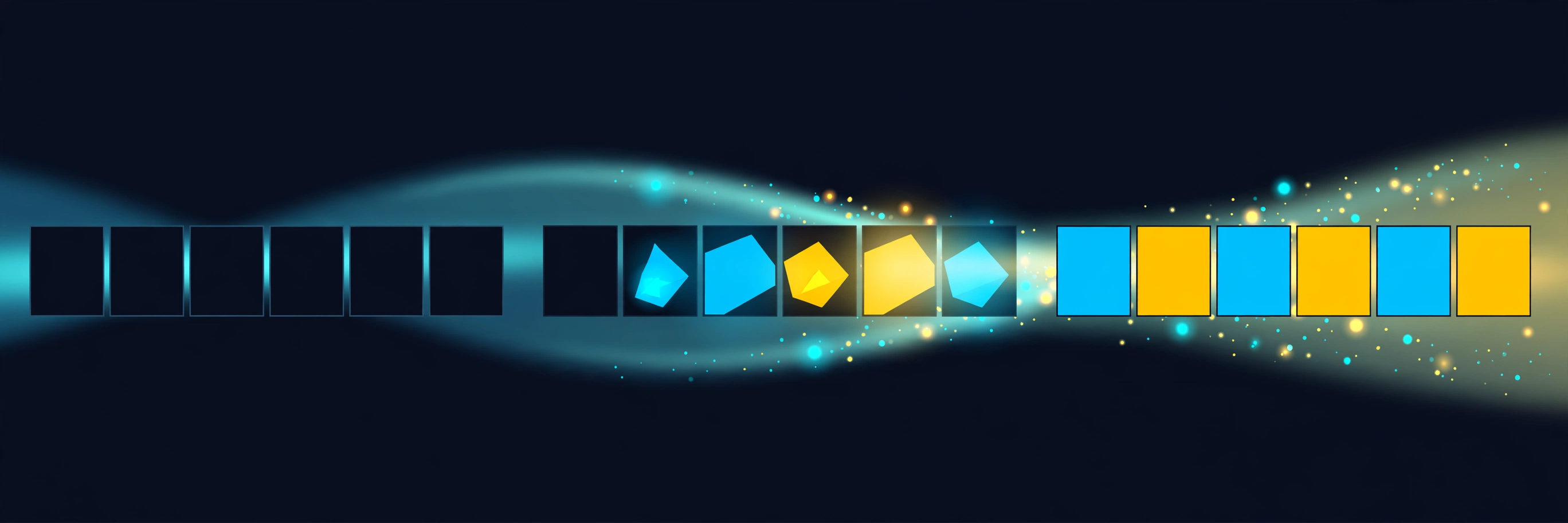
A diffusion language model is a language model that writes the way an image generator paints: it starts with a rough draft full of blanks, then refines the whole thing at once. Every chatbot you have used works the opposite way — it writes one word at a time, left to right, and can never go back and change a word it already chose.
The idea is borrowed from image generation, where diffusion powers Stable Diffusion, Midjourney, and DALL-E. Those models start from pure noise and remove a little of it at every step until a coherent picture emerges. A diffusion language model does the same thing with words: it starts with a sequence of placeholders, predicts every blank at once, keeps the predictions it is most confident about, and throws the rest away to try again. The model underneath is almost the same kind of transformer that powers ChatGPT and Claude — what changes is how it is trained and how it generates.
The first commercial diffusion language model was Mercury Coder, from Inception Labs, which claimed speeds above 1,000 tokens per second — five to ten times faster than the models it competes with. The field reached its turning point in 2024, when diffusion models first became competitive with traditional models on quality, and by 2026 the big labs had joined in: Google shipped Gemma Diffusion, Nvidia shipped Nemotron Diffusion, and Inception’s Mercury 2.5 reports 1,107 tokens per second with a 260,000-token context window.
2 How it works: the refine loop
Every diffusion language model runs the same four-step loop. Say you ask it to write a function that checks whether a number is even:
1. Mask — the model sees your prompt followed by a row of blanks, one for each word it will write. 2. Predict — it guesses a word for every blank at the same time, and scores how confident it is in each guess. 3. Keep the best — the confident guesses stay; the weak ones are thrown away and re-masked. 4. Repeat — the model runs the loop again on the remaining blanks, now with the good guesses as context, until nothing is blank any more.
The clever part is the trade-off the loop gives you. Keep everything from the first prediction and you are done in one step — very fast, but lower quality. Keep only the single best word each time and you take as many steps as there are words — slow, but careful. In practice the model commits a handful of its best guesses per step, which is why it is so much faster than writing one word at a time. And because every step can see the whole sentence — past and future — the model can fix a bad word in the middle after seeing what came after it. A traditional model can never do that: once a word is written, it is locked in.
Underneath, the mechanism is called masked diffusion, and the reference model is LLaDA, published in February 2025 by Nie and colleagues. It trains a plain transformer to reconstruct a whole sentence from a corrupted, masked version of it, and at generation time it denoises from fully masked to fully written. No new architecture was needed — just a different way of training and sampling the same kind of model.
3 Diffusion vs autoregressive
An autoregressive model — every mainstream chatbot today — generates text one token at a time, left to right. Each token needs a full pass through billions of parameters, and the attention mechanism only looks backward, at the words already written. It is like typing with no backspace: fast enough for a chat, but every word costs a full run of the model, and a mistake early in the sentence can quietly poison everything after it.
A diffusion language model predicts the whole sequence at once and refines it over a few rounds, rewriting every position in parallel. It can trade speed for quality on the fly — fewer steps when you want a quick draft, more steps when you want it careful — and it can revise any word at any time, because every step attends to the full sentence in both directions.
4 Why everyone’s building them now
Two stories in today’s briefing are the same story. Nvidia is in advanced talks to buy Inception for more than $500 million, plus performance-based earnouts, with all three co-founders expected to join — a deal that would bring the Mercury diffusion models into Nvidia’s Nemotron open-source line and its robotics work. And Apple is building an AI agent that can run your Mac, a job that needs a model fast enough to feel instant while it works across your apps.

The bet is simple. The most expensive part of running a chatbot is the waiting: every word costs a full pass through the model, and millions of users are waiting at once. A model that answers five to ten times faster, at a tenth of the cost, changes the economics of everything built on top of it — agents that act instead of chat, voice assistants that reply before you finish speaking, coding tools that rewrite whole files in a blink. Speed is not a nice-to-have here; it is the product.
That is also why the race is suddenly crowded. Google, Nvidia, and Inception all shipped diffusion models in 2026, and the research behind them is public — LLaDA showed the recipe works, and every lab can now cook from it. The company that ships the fastest good-enough model owns the layer underneath every agent, and Nvidia’s bid for Inception is a bet that the layer is about to change hands.
5 The honest part
First, the quality gap at the top is still real. Diffusion models are competitive on many tasks, but the best autoregressive models still lead on hard multi-step reasoning — the kind of thinking where each step depends on the last one being exactly right. Committing many tokens per step is faster, but it can produce locally incoherent output, so the best quality comes from unmasking fewer tokens per step, which gives back some of the speed. The trade-off is intrinsic, not a bug to be fixed away.
Second, the business is unsettled. Inception is shutting down its Mercury API on December 28, 2026, according to its own wind-down notice — the same week Nvidia is reported to be buying the company. Whether the deal closes or not, the message is that diffusion models are still a technology looking for their durable home: inside a chip company, inside a platform, or as a standalone product.
The honest summary: diffusion is the first serious challenger to the way every chatbot writes, and its speed advantage is real and measured. But the model that writes a sentence in one pass still has to prove it can think as carefully as the model that writes one word at a time — and the next year of benchmarks, not the next press release, will settle it.
Key terms
- Diffusion language model A language model that starts from a row of blank placeholders and refines the whole sequence in parallel, over a few rounds, instead of writing one word at a time.
- Autoregressive The standard way today’s chatbots write: one token at a time, left to right, each predicted only from the words before it.
- Mask / remasking A placeholder token that stands for a word not yet written. The model fills masks in, and can re-mask a weak guess to try again.
- Unmasking schedule The rule that decides how many of the model’s best guesses to keep at each step — more kept means faster, fewer kept means more careful.
- Token The smallest unit a model writes — roughly a word or part of a word. Speed is measured in tokens per second.
- Bidirectional attention Attention that lets every position see the whole sentence, past and future, so a word can be revised after seeing what follows it.
This lesson comes from today’s Daily Tech Briefing (Episode 39, November 20, 2026): Anthropic’s $107B debut, the AI sell-off & Nvidia’s subpoena. Read the full briefing: Anthropic’s $97 Debut — Daily Tech Briefing.
Kuleshov Group, “How to Build a Diffusion Language Model” (2026) — masked diffusion, the refine loop, Mercury 2, Gemma Diffusion, Nemotron Diffusion, and the 2024 turning point; Codecentric, “Diffusion Language Models: Beyond Left-to-Right Generation” — remasking, the speed-quality trade-off, and bidirectional attention; HackerNoon, “What Is a Diffusion LLM and Why Does It Matter?” — Mercury Coder launch, 1,000+ tokens per second, LLaDA (Nie et al., February 2025); The Information via Dealroom, “Nvidia is in advanced talks to buy diffusion-model startup Inception for at least $500M” (November 19, 2026) — the acquisition talks, the $500 million floor, and the co-founders joining Nvidia; The Neuron, “Nvidia’s Potential Inception Deal: Why Diffusion AI Matters” — the Mercury API wind-down on December 28, 2026.